
Tl;dr: Identity was the target in roughly half of all confirmed malicious activity. Prophet Security breaks down the four main attack patterns seen across customer environments between May and July 2026, and explains why some attacks succeeded while others were blocked.
Between May 1 and July 31, 2026, Prophet Security investigated every alert in customer environments immediately upon arrival. This removes a common blind spot in threat datasets: the human analyst’s decision about which alerts deserve a full investigation.
Of the completed investigations, about 93% were benign and 7% were confirmed malicious. The findings below come from that 7%. They are based on 4.7 million questions asked of customer environments over the quarter, with a median of 35 questions per investigation. Prophet Security published the full dataset in its first quarterly threat report.
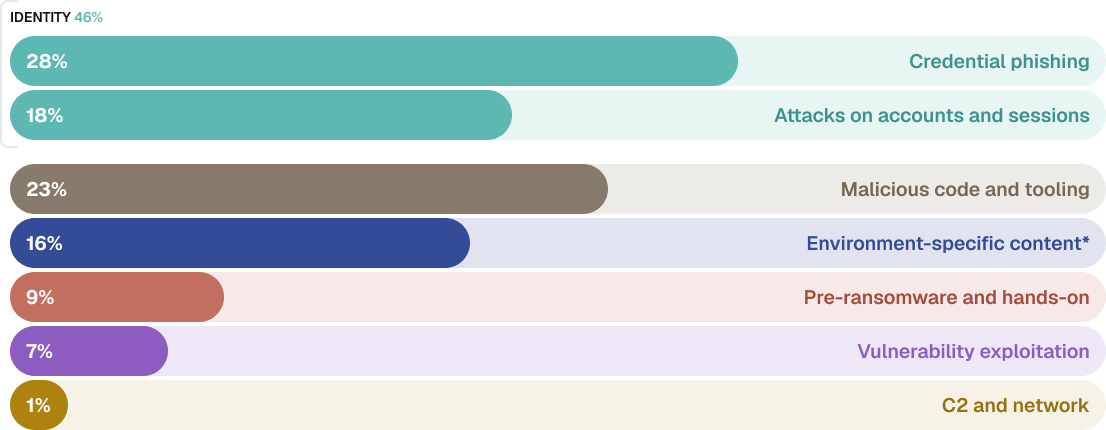
One key finding stands out: identity was the target in roughly half of all confirmed malicious activity this quarter. The strongest predictor of a successful account takeover was whether the attacker used a password or an already-authenticated session. This was true for both direct attacks on accounts and phishing campaigns.
Here are the four patterns we observed:
1. Session hijacking was the top way attackers broke into accounts
Direct attacks on accounts and sessions made up about 18% of confirmed malicious activity. These included session hijacking, token replay, MFA bypass, credential stuffing, and post-compromise persistence using inbox rules and OAuth consent grants. The main factor predicting success was the authentication method the attacker used.
Attempts using a password were usually blocked. For example, conditional access blocked correct passwords coming from commercial VPNs in new countries or unfamiliar hosting providers. Phishing-resistant MFA stopped adversary-in-the-middle proxies that captured credentials. The security controls worked as intended.
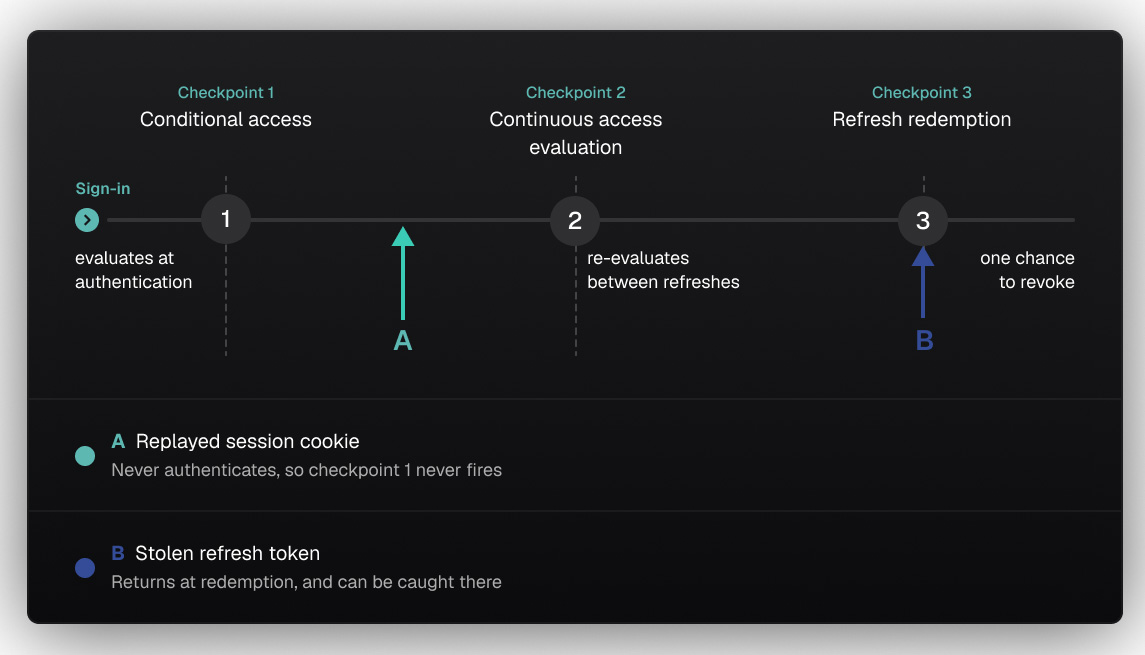
However, attempts using an already-authenticated session succeeded repeatedly. In some cases, individual accounts had dozens of malicious sign-ins over three weeks, giving attackers continuous access to emails. The reason is simple: standard conditional access checks during authentication.
Since a replayed session cookie skips authentication, no policy is triggered. A refresh token only returns to the identity provider when redeemed, which is the only time to re-evaluate and revoke access.
While passwords hit security controls, authenticated sessions bypassed them completely.
This led to two common outcomes. First, disabling the account didn’t always stop the attacker. At two organizations, attackers continued using access granted before the account was disabled.
In one case, they even changed authentication methods and granted OAuth consents while the security team thought the incident was closed. Second, when credentials were phished instead of sessions being stolen, the timing revealed relay infrastructure.
For example, a login from one country was followed by an MFA approval from another country just sixteen seconds later, and again after 118 seconds on a second attempt. Such a short gap between countries indicates a real-time proxy intercepting and relaying credentials and approvals.
MFA fatigue attacks also succeeded when allowed by the system. One attacker sent repeated prompts from a residential proxy until the user approved. Another used a combination of brute force, lockout, automatic unlock, and push bombing to register a new device, exploiting the automatic unlock policy.
The Prophet Security Quarterly Threat Report details a complete account takeover, from the initial login to the artifact that bypassed a password reset.
It also includes hardening recommendations for these threats.
2. Infostealers delivered via browsers were the primary source of stolen sessions
Malicious code execution and tooling accounted for about 23% of confirmed malicious activity. Overall, infostealer activity affected roughly a quarter of the investigated organizations.
These infostealers were mostly delivered through web browsers, not emails. Attackers used compromised legitimate websites, malicious ads, sponsored search results, and fake CAPTCHA gates (known as ClickFix) that bypass automated sandboxing by requiring a human click. Fake update prompts hosted on compromised sites were frequently seen across multiple organizations.
Attackers often lured users with software they wanted. Trojanized installers were the most common initial foothold, found at about a quarter of organizations. For example, a trojanized version of a popular AI application ran from a downloads folder, disabled Windows Defender, set up a highly privileged scheduled task, and opened command-and-control channels.
Similar techniques were used to hide malware in hardware diagnostic tools, public code packages, screenshot utilities, cracked software, and remote-support tools.
We identified delivery tools like ClearFake and SocGholish, and payloads including Lumma Stealer, Vidar, HijackLoader, and AsyncRAT.
While SocGholish infrastructure was disrupted on June 18, 2026 under Operation Endgame (during our reporting period), its fake update model continues to be used by ClearFake and other groups, showing that the technique survives even when the operators are shut down.
These stolen sessions often come from the browser’s cookie store. In one case, a script decrypted the browser’s cookie store, extracted Microsoft authentication cookies, and used them to make authenticated API requests. This is how attackers get the session cookies they replay to bypass security.
A stolen cookie requires no password or MFA, and it survives a password reset or even a device wipe if the session isn’t revoked. Ultimately, an endpoint compromise quickly becomes an identity compromise through the browser.
3. Phishing attacks were highly targeted
Credential phishing made up about 28% of confirmed malicious activity, making it the largest single category. These attacks primarily aimed to steal credentials or sessions rather than deliver malware.
These campaigns were highly targeted, often hitting the same people repeatedly. For example, one finance executive faced dozens of different phishing campaigns over three months. Another recipient was targeted for months, while someone else received near-identical phishing emails from different domains twice in two weeks.
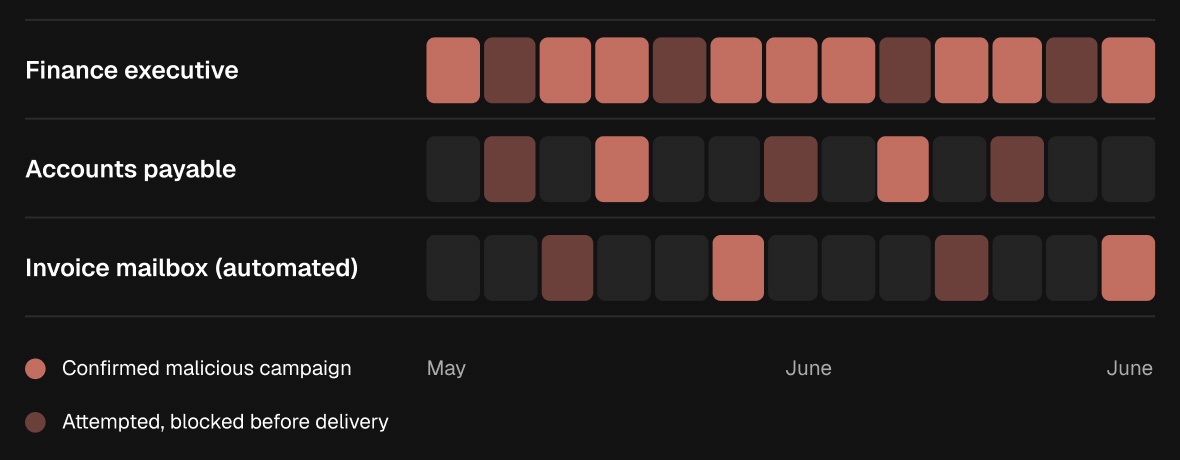
Attackers focused on financial roles: finance executives, collections, accounts payable, treasury mailboxes, and company leaders receiving ACH-themed lures. In one instance, they targeted an automated invoice-processing mailbox, which lacks a human user to spot suspicious activity.
The phishing emails often came from trusted infrastructure, such as legitimate collaboration platforms, major cloud email services, and consumer file-sharing links. Some messages impersonated internal systems like calendar services. Attackers used modern tactics: Unicode characters in subject lines to evade filters, newly registered domains, typosquatted domains, and tracking pixels to verify when an email was opened.
Standard email authentication checks weren’t always effective. In one case, a spoofed message that failed SPF, DKIM, and DMARC still reached over a dozen inboxes. The time it took to remove malicious emails varied from seconds to over a day.
Organizations with automated remediation removed emails in seconds. Without it, a CEO impersonation lure sat in a finance director’s inbox for nearly a full workday.
Once attackers gained access, they used mailbox rules to stay hidden. Modifying inbox rules was extremely common, seen at nearly as many organizations as impossible travel alerts. Attackers create rules to delete or hide incoming emails so the victim doesn’t see their replies. This simple persistence method survives a password reset and remains highly effective.
4. The longest intrusions occurred on unmonitored assets
Pre-ransomware and manual attacker activity made up about 9% of confirmed malicious activity. EDR was the broadest telemetry source behind these findings, and that volume is why investigating EDR alerts at depth is expensive. Most of this activity occurred on devices where no endpoint agent was installed at all.
For example, a multi-week credential attack targeted a production identity server lacking endpoint coverage. In another case, a six-week lateral movement campaign started from an unmanaged, unmonitored host. Several long-running intrusions were only detected because of telemetry from other network devices, as the attackers’ machines were entirely unmonitored.
When credential access was detected, it often involved legitimate Windows tools. Attackers used accessibility utilities, task manager, and error reporting services to access the Local Security Authority Subsystem Service (LSASS).
Other attackers bypassed LSASS, creating shadow copies to read credential data from the registry or using a legitimate remote registry service with an impersonation token.
Pre-ransomware activities such as destroying shadow copies, dumping credentials, and deploying remote access tools were much more common than actual ransomware deployment. In two instances, the attacks were stopped while they were still in progress.
About 15% of organizations had attackers using commercial remote access tools to maintain access. Attackers used consumer remote desktop software and remote support tools, which evade malware controls because they are legitimate applications. This access also survives a password reset.
Comparing endpoint agent coverage to authentication logs (instead of just the asset inventory) revealed unmonitored machines authenticating to the network. Two of the quarter’s longest-running campaigns operated from these unmonitored devices.
Summary of the quarter
Most of the confirmed attacks this quarter relied on well-known methods: stolen session cookies, MFA push bombing, fake software installers, and using publicly breached credentials. The only truly novel event was an AI agent running a complete intrusion, which began during a model evaluation with safety settings turned off and was eventually caught by another company’s security team.
The attack techniques haven’t changed much. Instead, attackers are simply bypassing existing security controls. When authentication became stronger, attackers started stealing active sessions. As malware detection improved, they began tricking users into approving fake installers.
This requires no innovation on the attacker’s side, only attention to where each control stops.
Three of our four findings share a critical trait: the attacker’s access survives a password reset. Stolen session cookies, hidden inbox rules, and persistent remote-support tools all bypass a simple password change. Incident response plans that stop at resetting a password leave the attacker inside the network, as two organizations in this dataset discovered.
Each case was ultimately resolved by asking basic questions and finding the answers: Has this account signed in from here before? Was MFA actually completed? Is this user a developer? Has this sender reached this recipient before? Answering these questions takes time. Often, they go unasked because analysts have to prioritize hundreds of other alerts.
About the data
These findings are based on investigations completed by the Prophet AI SOC Analyst between May 1 and July 31, 2026.
The category percentages represent shares of confirmed malicious investigations and are rounded. Authorized penetration tests and red team exercises were marked as benign and excluded from the malicious data. We do not publish identifying details, per-organization counts, or industry breakdowns.
Prophet Security is a leading agentic AI SOC platform, recognized in Rising in Cyber 2026 on a vote of more than 150 CISOs and security leaders. Its AI SOC analyst investigates every alert across endpoint, identity, email, cloud, and network telemetry and records the evidence behind each determination.
Read the full Quarterly Threat Report to see all four findings in depth, get hardening recommendations, and walk through a step-by-step reconstruction of an account takeover.
Sponsored and written by Prophet Security.