
The Cybersecurity and Infrastructure Security Agency (CISA) on Tuesday ordered U.S. government agencies to prioritize patching an actively exploited vulnerability in the Langflow visual framework for building AI agents.
Tracked as CVE-2026-0770, this critical security flaw allows unauthenticated threat actors to gain remote code execution as root in low-complexity attacks.
“The specific flaw exists within the handling of the exec_globals parameter provided to the validate endpoint,” Trend Micro researchers who found and reported the flaw explain. “The issue results from the inclusion of a resource from an untrusted control sphere. An attacker can leverage this vulnerability to execute code in the context of root.”

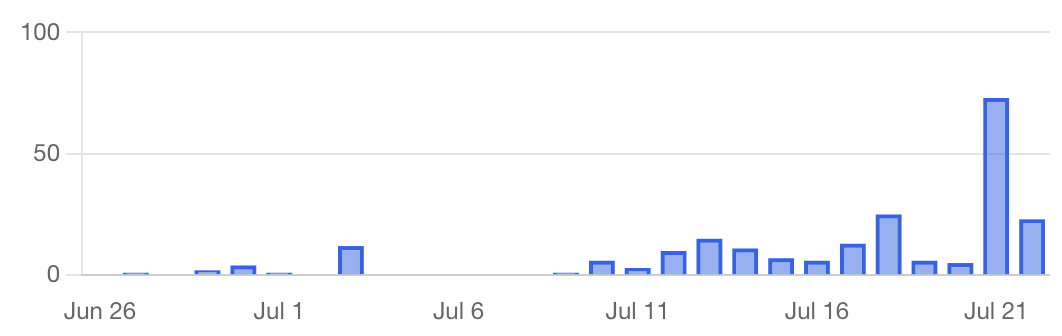
Vulnerability intelligence company KEVIntel first observed CVE-2026-0770 in-the-wild exploitation on June 27, with over 220 exploitation attempts recorded from 64 unique source IP addresses before CISA included the flaw in its Known Exploited Vulnerabilities (KEV) catalog.
KEVIntel founder Ryan Dewhurst told BleepingComputer that the malicious activity targeting the CVE-2026-0770 flaw is not limited to vulnerability checks, with malicious payloads observed during these attacks also attempting to deploy malware and obtain AWS credentials, environment variables, and container metadata.
“Most activity involved command-execution checks or system reconnaissance. However, KEVIntel also observed attempts to download second-stage scripts and access environment variables, cloud metadata and credential files,” Dewhurst said.
“Organizations operating Langflow should investigate historical requests to /api/v1/validate/code, review host activity, restrict access to the validation functionality and rotate exposed credentials where successful execution cannot be ruled out.”
Federal agencies ordered to take immediate action
On Tuesday, CISA added CVE-2026-0770 to its KEV catalog, ordering U.S. Federal Civilian Executive Branch (FCEB) agencies to secure their systems by Friday, as mandated by Binding Operational Directive (BOD) 26-04.
“This type of vulnerability is a frequent attack vector for malicious cyber actors and poses significant risks to the federal enterprise,” the cybersecurity agency warned.
“Stakeholders are responsible for evaluating each asset’s internet exposure and ensuring adherence to BOD 26-04 patching guidelines.”
CISA has flagged other Langflow vulnerabilities as exploited in the wild in recent years, including a missing authentication security issue (CVE-2025-3248) in May 2025, a code injection vulnerability (CVE-2026-33017) in March 2026, and an Insecure Direct Object Reference (IDOR) security flaw (CVE-2026-55255) earlier this month.
The cybersecurity agency also confirmed that CVE-2025-3248 is being exploited in ransomware attacks, after cloud security company Sysdig reported that the JadePuffer ransomware gang is using it to dump Langflow PostgreSQL databases.

Security teams log 54% of successful attacks and alert on just 14%. The rest move through your environment unseen.
The Picus whitepaper shows how breach and attack simulation tests your SIEM and EDR rules so threats stop slipping by detection.