
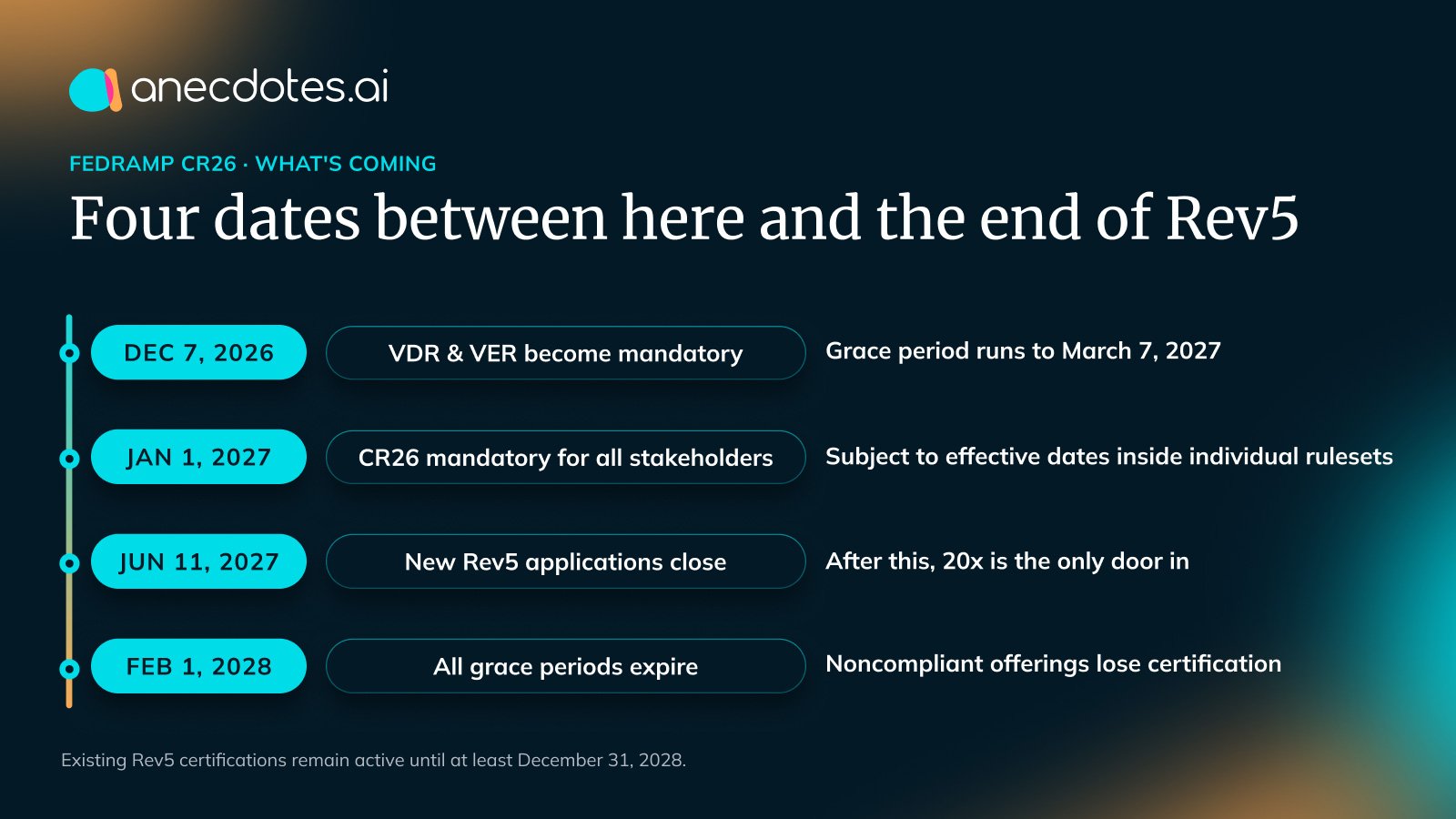
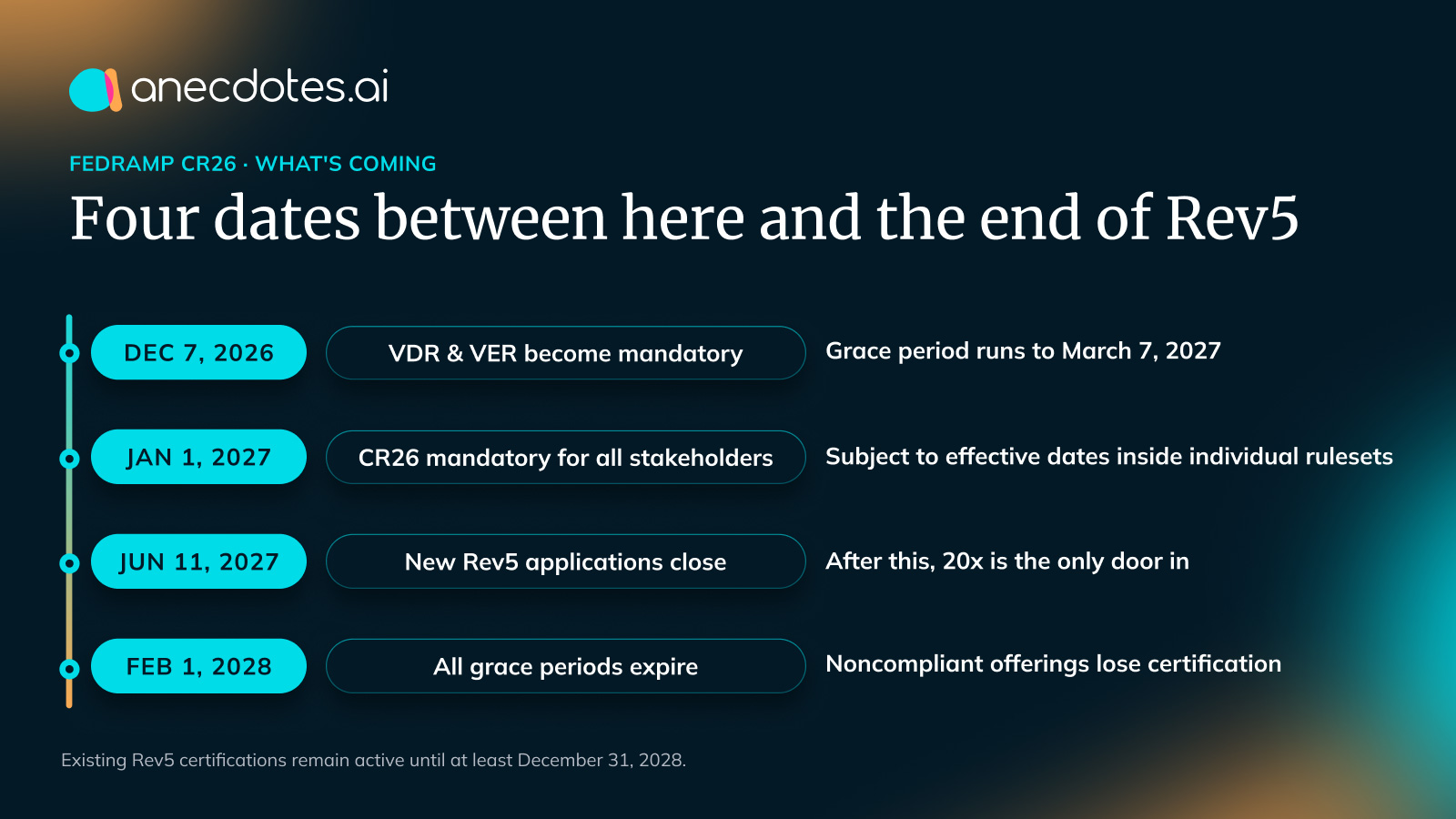
If you hold a FedRAMP certification, the nearest deadline on your calendar is December 7, 2026. FedRAMP’s notice responding to CISA’s BOD 26-04 puts it plainly: “The Vulnerability Detection and Response rules will be mandatory for all cloud service offerings obtaining or maintaining FedRAMP Certification effective December 7, 2026,” with a grace period through March 7, 2027 for offerings operating under a corrective action plan.
It is also the deadline most programs have not fully scoped. The problem is not the date. It is that VDR and VER read like a scanning requirement and operate like something else entirely.
What the two rulesets actually change
Start with what is retired: the flat monthly-scan-and-POA&M model. Detection frequency is now set by certification class — under rule VDR-TFR-PSD, machine-based resources are scanned at least every 14 days at Class A, every 7 at Class B, every 3 at Class C, and at least once per day at Class D.
Machine verification and validation runs at least monthly for Rev5 holders, and as often as every three days at higher 20x classes.
Then the three provisions that reshape engineering work:
Remediation clocks are tiered and tight. Under VDR-TFR-PVR, fix deadlines are set by a vulnerability’s PAIN rating and its exploitability, running from 192 days at the low end to 12 hours at the extreme — a Class D offering with a PAIN-5 vulnerability that is both likely exploited and immediately remotely exploitable.
A 12-hour clock is not a ticket-queue SLA. It is a paging and ownership question, and it has to hold on a holiday weekend.
The burden of proof inverted. VER-EVA-AIA — “Assume It’s Automatable” — requires providers, in FedRAMP’s words, “to assume exploits are automatable by default, unless they have evidence providing otherwise.” Every deferral now needs a defensible artifact behind it, produced at volume, on the same clock as everything else.
Process failures count as vulnerabilities. Rule VDR-CSO-FAV states that providers “[MUST] treat problems or failures with their vulnerability detection and response processes as vulnerabilities.” If your detection pipeline silently stops, that is not an operational hiccup you fix quietly before anyone notices. The system that produces your evidence is itself in scope.
Read together, those change the deliverable. You are not being asked to scan more often. You are being asked to run a system that produces defensible, current, machine-readable answers about your own exposure — and to be accountable when it stops running.
What the December 7 rulesets require in practice — daily detection, monthly machine validation, tiered remediation clocks, and process failures as findings — plus how continuous coverage validation is computed from live asset data rather than attested.
December 7 is the first installment, not a one-off
The Consolidated Rules for 2026 reorganized FedRAMP into rulesets and started the clock on a much larger change.
Rev5 is not being maintained alongside 20x: FedRAMP describes it as “a legacy FedRAMP Certification process that is being replaced entirely by FedRAMP 20x,” and says providers “are expected to follow new rules and adopt new FedRAMP Practices from FedRAMP 20x into their FedRAMP Rev5 Certified cloud service offerings.”
The rules become mandatory for all stakeholders on January 1, 2027, and FedRAMP stops accepting new Rev5 applications on June 11, 2027.
So VDR and VER are not a detour you take before the real transition. They are the transition, arriving in installments — and that reframe is the most useful thing available to a program right now, because it changes sequencing.
Work scoped as “get through December” gets rebuilt in 2027. Work scoped as the first slice of continuous validation transfers.
What got removed tells you where this is going
Look at the structural changes rather than the deadline table. The System Security Plan and its appendices give way to a Certification Package Overview and a Security Decision Record. Plans of Action & Milestones, FedRAMP writes, “have been eliminated entirely and replaced with a list of Accepted Weaknesses.”
Continuous Monitoring becomes Ongoing Certification — renamed, FedRAMP explains, because “continuous monitoring” had “become synonymous with ‘vulnerability scans'” and the new requirements are “far broader than before.”
Every one of those was a place where the artifact stood in for the reality. FedRAMP was unusually direct about closing them, telling providers they will need to build or buy modern GRC capabilities and “populate them using automation based on real-world data where possible, rather than maintaining artisanal hand-crafted documents.”
Here is what deadline coverage keeps missing: almost none of this is a demand for new security. Access control, identity, encryption, logging, incident procedures, training — largely intact, largely reusable.
What changed is that describing them no longer counts as evidence of them.
Three judgments that separate the programs that make it
The work is still compliance; the deliverable is now engineering. What you hand over is a set of running validations that pull from the systems holding the truth — cloud configuration, identity provider, SIEM, CI/CD, ticketing — and emit machine-readable results on a schedule.
Providers must persistently validate their Key Security Indicators, of which CR26 currently lists 49 across ten categories. That is an entry requirement, which makes every transition plan an automation engineering plan underneath whatever it says on the cover.
Someone has to own “continuous.” Monthly monitoring had a due date, an owner, and a natural rhythm of catching up. A validation cadence has none of those. It runs, or it silently stops, and the difference is invisible until an assessor or a customer finds it.
Before building pipelines, answer the operational questions: who is paged when a validation fails, what the response time is, who notices when an evidence source quietly changes its API.
Design for the cadence, not the submission. FedRAMP defines persistently as “occurring in a firm, steady way that is repeated over a long period of time in spite of obstacles or difficulties” — a description of an operating state, not a date.
Teams that build toward a submission build a system tuned for a single moment and then rebuild it afterward.
The part that outlives FedRAMP
Once evidence is structured data rather than narrative, it stops belonging to a framework. The identity evidence satisfying a FedRAMP indicator is the same evidence a SOC 2 auditor wants and the same evidence a large customer’s diligence team asks for.
Compliance stops being parallel projects that each rebuild the same picture in a different vocabulary and becomes one substrate that many consumers read from.
The economics invert along with it. Point-in-time compliance costs rise with every framework and every region you add, because each addition is more description to produce and maintain. Continuous validation costs materially more to stand up and barely more to run.
December 7 is a hard date, and it deserves the attention it is getting. But financial-services supervisors, the EU’s resilience and product-security regimes, and enterprise procurement teams are converging on the same demand from different directions: show me current state, not last year’s description.
FedRAMP arrived first because it had the clearest mandate and the least patience. A team that builds this once has not solved a federal problem — it has built the capability every one of those demands will keep asking for.
anecdotes holds a FedRAMP 20x Class C certification, earned as a Phase Two pilot participant, using the anecdotes platform to run it. The same platform runs commercial compliance for more than 140 enterprise customers.
Standard basis: FedRAMP Consolidated Rules for 2026 and FedRAMP Notice NTC-0014. Rules and Key Security Indicators change through FedRAMP’s public rules process; confirm the live standard at fedramp.gov before baselining your plan.
Learn how Anecdotes helps you operationalize VDR & VER and download the technical solutions brief here.
Sponsored and written by Anecdotes.